What is the Needle Gauge of a Disposable Sterile Insulin Syringe?
As a supplier of disposable sterile insulin syringes, understanding the concept of needle gauge is crucial not only for providing accurate information to customers but also for ensuring the quality and suitability of our products.
Understanding Needle Gauge
The needle gauge of a syringe refers to the diameter of the needle. It is expressed as a number, and there is an inverse relationship between the gauge number and the needle diameter. That is, the higher the gauge number, the thinner the needle. For instance, a 30 - gauge needle is thinner than a 27 - gauge needle.
In the context of insulin syringes, needle gauge plays a significant role in both the injection process and patient comfort. A thinner needle (higher gauge) generally causes less pain during injection because it penetrates the skin with less trauma. However, it may also be more fragile and slower to deliver the insulin.
Thicker needles (lower gauge) are sturdier and can deliver insulin more quickly. They may be more suitable for patients with thicker subcutaneous tissue, such as some obese patients. For example, a 27 - gauge needle might be a good choice for those who find it difficult to use very thin needles due to the nature of their body tissue.
Common Needle Gauges in Disposable Sterile Insulin Syringes
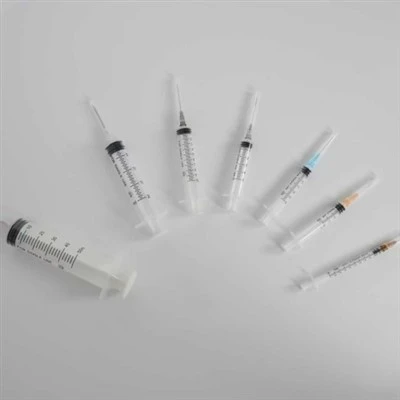
In the market, the most common needle gauges for disposable sterile insulin syringes range from 28 to 33 gauge.
The 28 - gauge needle is relatively thick compared to higher - gauge needles. It is strong enough to penetrate the skin easily, which makes it suitable for patients who are new to insulin injection or those who may have some difficulty using very fine needles. Insulin is delivered relatively quickly through a 28 - gauge needle, reducing the time of injection.
30 - gauge needles are widely used. They offer a good balance between pain reduction and efficient insulin delivery. Many patients find that the pain associated with a 30 - gauge needle is tolerable, and it can still deliver the insulin at an acceptable rate.
The 31 - gauge and 32 - gauge needles are even thinner. They are designed to minimize pain during injection, which is especially beneficial for patients who are sensitive to pain or need to inject insulin multiple times a day. These thinner needles are more flexible, but they may require a bit more care during use to avoid bending or breaking.
The 33 - gauge needle is the thinnest commonly available in insulin syringes. It is ideal for patients who are extremely sensitive to pain. However, due to its thinness, the flow rate of insulin may be slower, and it requires a gentle touch during injection.
Factors Affecting the Choice of Needle Gauge
Several factors influence the choice of needle gauge for a disposable sterile insulin syringe.
Patient's Skin and Tissue Characteristics: As mentioned earlier, patients with thicker subcutaneous tissue may benefit from a lower - gauge (thicker) needle. For example, obese patients often require a needle that can penetrate the extra layer of fat to reach the appropriate injection site. On the other hand, patients with thin skin or less subcutaneous tissue may find a higher - gauge (thinner) needle more comfortable.


Patient's Pain Tolerance: Some patients are more sensitive to pain than others. Those with low pain tolerance usually prefer higher - gauge needles, which cause less pain during injection. This is particularly important for patients who need to administer insulin multiple times a day, as minimizing pain can improve their compliance with the treatment regimen.
Insulin Type and Injection Technique: Different types of insulin may have different viscosities. Thicker insulin formulations may require a lower - gauge needle to ensure smooth delivery. Additionally, the injection technique used by the patient can also affect the choice of needle gauge. For example, if a patient has a firm and steady hand, they may be able to use a thinner needle with more ease.
Our Products and Needle Gauges
At our company, we offer a wide range of disposable sterile insulin syringes with different needle gauges to meet the diverse needs of our customers.
Our Insulin Syringe for Diabetic Use is available in multiple needle gauges from 28 to 33. This allows diabetic patients to choose the most suitable option based on their individual requirements. Whether they need a thicker needle for easier penetration or a thinner one for minimal pain, our product line has them covered.
The Insuline Sterile Safety Syringe with Orange Top is designed with safety in mind. It comes in various needle gauges, and the safety features ensure that the needle is properly protected after use, reducing the risk of accidental needle - stick injuries.
Our Insulin Safety Syringe1ml Needle Luer Lock offers a 1ml capacity with a luer - lock needle connection. Patients can choose from different needle gauges depending on their insulin dosage and injection preference.
The Sterile Diabetic Insulin Syringes are manufactured under strict sterile conditions. They are available in a range of needle gauges, providing diabetic patients with high - quality and safe options for insulin injection.
Our Disposable Sterile Insulin Safety Syringe combines the benefits of sterility, safety, and a choice of needle gauges. It is designed to provide a reliable and comfortable insulin injection experience for patients.
Importance of Quality in Insulin Syringes
The quality of disposable sterile insulin syringes is of utmost importance. Not only does it ensure the accurate delivery of insulin, but it also affects patient safety and comfort.
A high - quality syringe should have a sharp and burr - free needle to minimize pain during injection. The needle should be securely attached to the syringe barrel to prevent detachment during use. Additionally, the syringe should be made of materials that are compatible with insulin and do not cause any chemical reactions.
Our company is committed to providing the highest quality disposable sterile insulin syringes. We use advanced manufacturing processes and strict quality control measures to ensure that every syringe meets the highest standards. This includes testing the needle gauge accuracy, the sterility of the product, and the functionality of the syringe.
Contact Us for Purchase and Negotiation
If you are interested in our disposable sterile insulin syringes and would like to discuss the product details, pricing, or place an order, please feel free to reach out. We are here to provide you with the best products and services. Whether you are a medical institution, a distributor, or an individual patient, we welcome your inquiries and look forward to establishing a long - term business relationship.