For medical distributors, hospital procurement teams and home care suppliers, matching between urine bags and urinary catheters directly affects drainage smoothness and patient safety. Poor connection often causes leakage, disconnection or blocked fluid flow, which disturbs clinical nursing work and raises infection risks. It is one of the most frequently raised technical questions by global buyers of disposable urine bags: What is the catheter tube specification, and is the inlet adapter compatible with most standard urinary catheters?
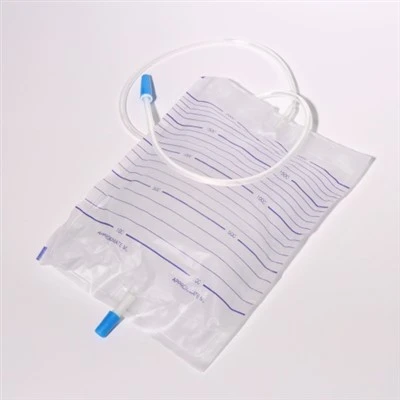
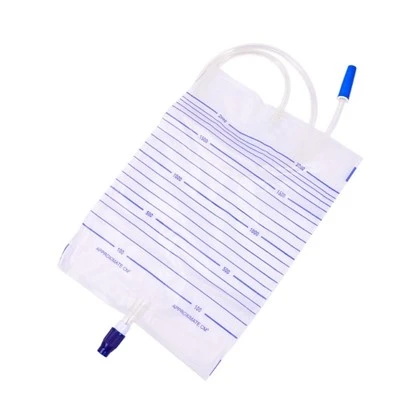
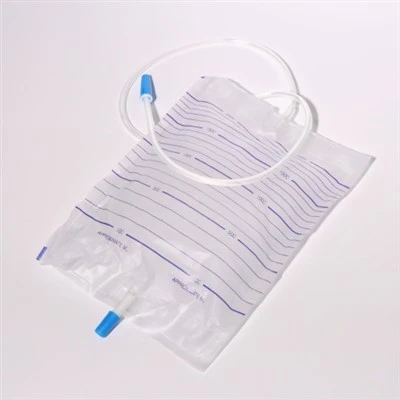
The drainage tube fitted on this disposable urine bag comes with clear fixed parameters. Its outer diameter is 6.5 mm and total length reaches 90 cm. Made of medical-grade transparent PVC, the tube features a smooth inner wall and anti-twist design. This design effectively prevents blockage when patients roll over or adjust body positions, keeping urine flowing steadily during long-time drainage. The material maintains proper softness without collapsing under gravity, a basic guarantee for continuous gravity drainage in wards, rehabilitation centres and home nursing scenarios.
As for compatibility, the standard inlet adapter is engineered to fit most mainstream urinary catheters widely used in global markets. The tapered connecting structure delivers a tight, leak-proof fit for common Foley catheters used in adult urinary drainage. A blue protective cap is attached to the adapter, shielding the sterile connecting port from contamination before assembly, which supports standard aseptic operation required by hospital infection control protocols.
Even with universal design, the manufacturer reminds buyers of reasonable limits. While the adapter works for the majority of standard catheter models, special customized catheters or non-standard tapered joints may not form a reliable seal. For clients serving specialized departments or regional markets with unique catheter specifications, custom connectors can be developed through OEM cooperation. This flexible solution helps wholesale partners avoid mismatched accessories after bulk shipment.
Consistent production control keeps connector dimensions stable batch after batch. The factory follows ISO 13485 quality management standards, and all finished products hold CE certification. Each mould for tubes and adapters undergoes regular inspection, so the connecting size will not drift between different production runs. This stability matters greatly for bulk buyers, as hospitals and nursing homes usually stock urine bags and catheters from separate suppliers. Stable interface size reduces nursing confusion and lowers complaint rates.
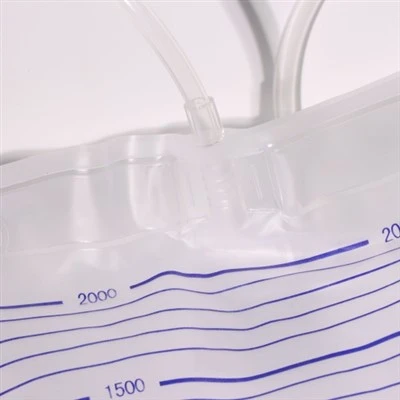
The whole set of tubing and adapter works together with other functional parts of the urine bag. The anti-reflux valve inside stops urine backflow once the bag is hung below the patient's bladder, while the T-type drain valve allows one-handed operation for urine release. Clear dual-sided printed scales help nurses observe urine volume and sediment without extra measuring tools. The integrated double hanging rings fix the bag firmly on bed frames or infusion stands, preventing accidental pulling at the joint.
For wholesale clients, the supplier can provide dimensional inspection reports and assembly test records for reference. If buyers plan to combine this urine bag with their own branded catheters, pre-sample matching tests are strongly recommended before formal orders. The team also accepts custom tubing length or connector redesign based on local clinical habits, with clear MOQ rules for OEM adjustments.
In clinical practice, reliable connection is the first step of safe urine management. With a standard 6.5 mm outer diameter, 90 cm anti-kink tube and widely adaptable inlet adapter, this disposable urine bag suits most routine urinary drainage cases. It simplifies material preparation for medical facilities and brings stable, low-risk supplies to global medical distributors.